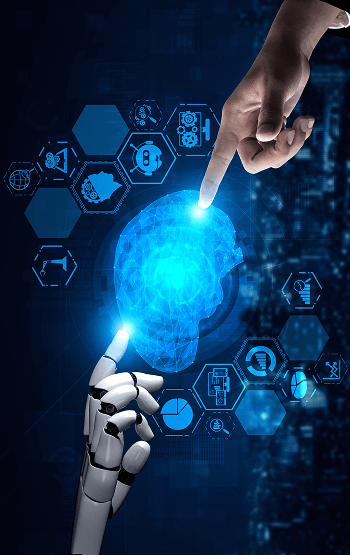
In today’s rapidly evolving technological landscape, Artificial Intelligence (AI) is no longer a futuristic concept but a present-day reality, driving significant changes across various sectors. A key component of this transformation is the rise of AI Agents. Xccelerance Technologies is committed to exploring and explaining these advancements. In this blog, we delve into the world of AI Agents, examining their impact and potential.
AI Agents are autonomous software programs capable of performing tasks, making decisions, and interacting with their environment. Unlike traditional software that requires constant human input, AI Agents use artificial intelligence to operate independently, adapting to changes and learning from data. This capability allows them to automate processes, improve efficiency, and provide personalized services, revolutionizing how businesses operate. Think of them as digital employees capable of handling complex tasks without constant supervision.

Use Cases by Industry
The application of AI Agents is widespread and diverse. As of 2025, AI agent adoption is accelerating. A Capgemini survey notes that 82% of organizations plan to integrate AI agents by 2026, mainly for tasks like coding, data analysis, and email generation. Let’s explore how different industries are leveraging these intelligent systems, with added insights into the underlying mechanisms:
Healthcare:
- Patient Monitoring: AI Agents continuously monitor patients’ vital signs, alerting medical staff to abnormalities. This early detection can reduce hospital readmissions by up to 20% (American Hospital Association). This is achieved through the use of machine learning algorithms trained on vast datasets of patient data, allowing them to identify subtle patterns that might be missed by human observation.
- Treatment Optimization: They analyze patient data to suggest personalized treatment plans, potentially improving recovery rates by 15% in chronic disease management (McKinsey). AI Agents can consider a multitude of factors, including genetic predispositions, lifestyle choices, and responses to previous treatments, to tailor plans far beyond the capabilities of traditional methods.
- Medical Image Analysis: AI Agents automate the analysis of medical images (X-rays, CT scans, MRIs), leading to faster and more accurate diagnoses, and reducing radiologist workload. Some systems achieve up to 61% accuracy in breast cancer detection (Ezra). Deep learning models, particularly convolutional neural networks (CNNs), are used to identify subtle anomalies in images, often surpassing human-level accuracy in specific diagnostic tasks.
- 90% of hospitals are expected to adopt AI agents by 2025 (Salesforce, 2024).
Finance:
- Investment Management: Robo-advisors manage portfolios, optimizing returns based on market conditions. They can reduce management fees by up to 50% compared to traditional advisors (Betterment). These agents use algorithms that can analyze market trends, predict future performance, and adjust investment strategies in real-time, often outperforming human fund managers.
- Fraud Detection: AI Agents analyze transactions in real-time to flag suspicious activity, enhancing security, and reducing losses by 25% (JPMorgan Chase). Anomaly detection algorithms are employed to identify unusual patterns in transaction data, such as atypical transaction sizes, locations, or times, providing an extra layer of security.
- Credit Risk Assessment: They automate loan approvals by evaluating borrower data, streamlining the process and speeding up loan processing by 40% (Deloitte). AI Agents can analyze a broader range of data points than traditional credit scoring models, including social media activity and online behavior, to assess creditworthiness more accurately.
Retail:
- Personalized Marketing: AI Agents analyze customer data to create tailored offers, boosting engagement and sales. Amazon attributes 35% of its sales to personalized recommendations (Forbes). These agents utilize collaborative filtering and content-based filtering techniques to recommend products based on past purchases, browsing history, and the preferences of similar customers.
- Inventory Management: They predict demand to automate stock orders, minimizing stockouts and overstocking, reducing stockouts by 25% and overstock by 15% (Gartner). Time-series forecasting models and machine learning algorithms are used to predict future demand based on historical sales data, seasonality, and external factors like economic trends.
- Customer Service Chatbot: AI-powered chatbots provide 24/7 support, improving customer satisfaction and resolving issues 44% faster (Intercom’s 2024 Customer Service Trends Report). Natural Language Processing (NLP) allows these chatbots to understand and respond to customer inquiries in a human-like manner, handling a large volume of requests simultaneously.
- 69% of retailers using AI agents report significant revenue growth (Statista, 2024).
Manufacturing:
- Predictive Maintenance: AI Agents monitor equipment to schedule maintenance, reducing downtime by 30% and lowering maintenance costs by 20% (Binmile). Sensors collect data on machine performance, and AI algorithms analyze this data to predict when maintenance is needed, preventing unexpected breakdowns.
- Quality Control: They use vision systems to detect defects, ensuring product quality and reducing waste by 10%(McKinsey). Computer vision algorithms, often based on deep learning, are trained to identify defects in products with high accuracy, even those that are difficult for the human eye to detect.
- Supply Chain Optimization: AI Agents analyze data to streamline procurement and distribution, reducing lead time by 20% and inventory costs by 35% (Georgetown Journal of International Affairs). AI optimizes supply chain by predicting demand, managing inventory, and improving logistics to save costs.
Education:
- Virtual Tutor: AI tutors adapt learning to individual student needs, offering real-time feedback, and enhancing educational outcomes, increasing test scores by 62% (SpringerOpen). These agents use personalized learning algorithms to tailor the learning experience to each student’s pace and style, providing customized exercises and feedback. AI tutors adapt learning to individual student needs, offering real-time feedback, and enhancing educational outcomes, increasing test scores by 62% (SpringerOpen). These agents use personalized learning algorithms to tailor the learning experience to each student’s pace and style, providing customized exercises and feedback.
- Automated Grading: They grade assignments instantly, saving educators time and providing quick feedback. Teachers can save 10 hours per week with 90% grading accuracy. NLP and machine learning techniques are used to assess written assignments, providing consistent and objective grading.
- Content Generation: AI Agents create and update course materials, ensuring relevance and reducing preparation time by 25% (EDUCAUSE). AI can generate quizzes, summaries, and even entire lesson plans, keeping educational content up-to-date with the latest research and trends.
Read More – Software-Driven Future of the Automotive Industry
Transportation:
- Traffic Management: AI optimizes traffic flow, reducing congestion, travel times by 15% and fuel consumption by 10% (Upper Inc). Real-time data from sensors and cameras is analyzed to adjust traffic light timings and optimize routes, improving overall traffic flow.
- Fleet Management: They manage vehicle routes and maintenance, lowering operational costs by 30% (Binmile). AI algorithms optimize routes, schedule maintenance, and monitor driver behavior, leading to increased efficiency and reduced fuel consumption.
- Autonomous Vehicles: AI controls self-driving cars, enhancing road safety, and accessibility. Waymo reports a 75% decrease in accidents (Waymo 2024 safety report). These vehicles use a combination of sensors, cameras, and AI algorithms to perceive their surroundings, make decisions, and navigate roads safely.
Agriculture:
- Precision Farming: AI monitors crops and adjusts resources, increasing yields by 20% and reducing water usage by 30% (FAO). Sensors collect data on soil conditions, weather patterns, and crop health, and AI algorithms use this data to optimize irrigation, fertilization, and pest control.
- Disease Detection: They analyze plant data for early disease detection, improving crop health and reducing crop losses by 25% (Nature). Computer vision and machine learning detect early signs of plant diseases, enabling prompt intervention.
- Automated Harvesting: AI Agents control robots to pick produce, boosting efficiency by 40% (AgFunder). Robots equipped with computer vision can identify ripe produce and harvest it with precision, reducing labor costs and minimizing waste.
Energy:
- Smart Grid Management: AI balances energy supply and demand, improving grid stability by 15% (IEA). AI algorithms predict energy demand, optimizing distribution from diverse sources, ensuring stable power supply.
- Energy Efficiency in Buildings: They adjust building systems to minimize energy use, cutting costs by 20% (CIBSE). AI manages HVAC, lighting systems efficiently by adjusting based on occupancy and conditions.
- Predictive Maintenance: AI monitors infrastructure to prevent failures, ensuring reliable energy supply and reducing downtime by 25% (EPRI). Similar to manufacturing, AI predicts equipment failures in power plants and transmission lines, allowing for proactive maintenance.
Media and Entertainment:
- Content Recommendation: AI suggests personalized content, enhancing user engagement. Netflix attributes 80% of viewership to recommendations (Netflix 2024 investor report). Similar to retail, collaborative filtering and content-based filtering are used to recommend movies, shows, and music based on user preferences.
- Automated Content Creation: They generate articles and videos, increasing productivity by 50% (Writesonic). AI can generate news articles, social media posts, and even video scripts, freeing up human writers and creators to focus on more complex tasks.
- Customer Service Chatbot: AI handles inquiries 24/7, improving service. NLP-powered chatbots provide instant support to customers, handling common inquiries and resolving issues quickly.
Government:
- Citizen Services: AI automates services like license renewals, improving accessibility, and reducing processing time by 30% (Deloitte). AI-powered chatbots and online portals provide citizens with 24/7 access to government services, streamlining processes and reducing wait times.
- Data Analysis for Policy Making: They analyze data to inform decisions, enhancing public service efficiency by 15% (OECD). AI analyzes data for trends and patterns to inform policy decisions, improving government services.
- Cybersecurity: AI monitors networks for threat detection, protection sensitive information. AI algorithms detect and respond to cyber threats in real time, protecting government networks and data from attacks.
Human Resources (HR):
- Recruitment and Hiring: AI screens candidates and schedules interviews, reducing recruitment time by 50% (Carv). AI automates resume screening, identifies qualified candidates, and schedules interviews, saving recruiters time.
- Employee Engagement and Retention: They analyze data to predict attrition, fostering a positive work environment and boosting retention by 82% (AIHR). AI can identify employees who are at risk of leaving the company, allowing HR to intervene and address their concerns.
Marketing:
- Content Creation and Optimization: Generates marketing content and optimizes for SEO, improving engagement, and achieving 47% higher organic traffic (Igebra.ai). AI can generate blog posts, social media updates, and ad copy, optimizing the content for search engines and target audiences.
- Customer Segmentation and Personalization: Delivers tailored messages and offers, boosting conversion rates by 25% (McKinsey). AI analyzes customer data to segment audiences and personalize marketing campaigns, increasing their effectiveness.
An Unexpected Benefit
Beyond the expected efficiencies, AI Agents offer surprising benefits. In agriculture, for instance, precision farming not only increases yields but also significantly reduces environmental impact by optimizing resource use. This contributes to more sustainable farming practices, highlighting the broader positive implications of AI Agent adoption. This demonstrates the potential of AI to address global challenges beyond purely economic gains.
The Future of AI Agents
AI Agents will continue to evolve, becoming more autonomous and capable of making complex decisions with minimal human intervention. They are expected to play an increasingly significant role in various aspects of business and daily life. There is an anticipation for hyper-personalization, where AI agents will create tailored experiences and services. Additionally, developments in self-healing systems, where AI agents monitor, identify, and autonomously resolve issues, are on the horizon. Advancements include reinforcement and federated learning, enabling agents to learn collaboratively without sharing sensitive data.
Conclusion
AI Agents are undeniably transforming industries, offering unprecedented opportunities to enhance efficiency, improve decision-making, and deliver personalized experiences. Adoption has challenges like job displacement, needing new skills, yet the benefits are compelling. Xccelerance Technologies believes that understanding and embracing these advancements is crucial for businesses and individuals alike.
AI Agents will evolve into partners, shaping the future by enhancing human productivity and creativity through collaboration.